Review of "A Disturbance in the Force: How and Why the Star Wars Holiday Special Happened"
By Eric — — 4 minute read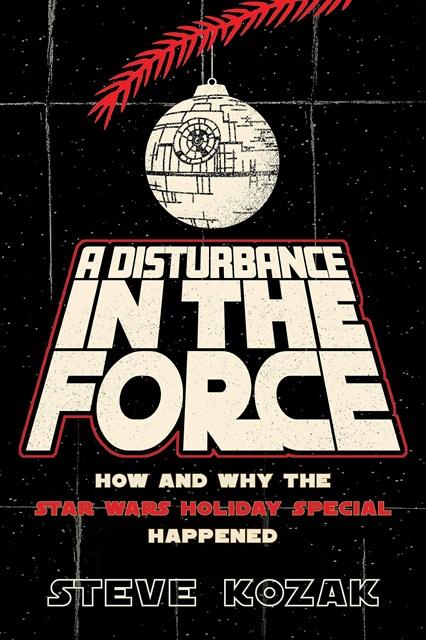
My fifth-grade teacher required us to write in a journal during class. She would often supply a topic that we would write about. My entries in the fall of 1978 indicated a bit of an obsession:
- If I had three wishes: Wish number 1: The Millennium Falcon
- Happiest moment: Seeing Star Wars for the first time
- Best Movie I Ever Saw: STAR WARS (had seen it 10 times at that point)
- Favorite Car: Corvette from Corvette Summer (that starred Mark Hamill)
- Favorite Books: Fight in the Mountains and Star Wars (which I claimed to have read almost 5 times)
- My Favorite Hero: Luke Skywalker is my hero (followed by much of the blurb from the back of the novel)
- TV Shows: Battlestar Galactica and Mork and Mindy
- My Hobbies: Among a couple of other things, Star Wars (the movie, the book, as well as Splinter of the Mind's Eye, a follow-up Star Wars novel)
It is inconceivable that there was a Star Wars TV show airing November 17th that year and I didn't watch it. But my journal doesn't mention it. These could be fake memories, but I think I talked it up to my family (since there was one TV and 7 people with potential opinions about what to watch) and later felt like I might have over-sold it.
Even though my Star Wars obsession faded away with my childhood, Steve Kozak's book about the Holiday Special was super-interesting to me for the things I learned. Referring to my list above, I didn't realize that Alan Dean Foster, who wrote Splinter of the Mind's Eye had ghost written the original Star Wars novel attributed to George Lucas. I was also delighted to read that Robin Williams had been considered for a role in the Holiday Special but was deemed insufficiently famous since Mork and Mindy hadn't aired before the Holiday Special's casting.
But the most eye opening part was the view into the film and television production process and business, being totally new to me. Part of the motivation for creating the Special was to keep up audience awareness in the years until The Empire Strikes Back would come out -- with industry insiders suggesting to Lucas that they'd otherwise soon forget all about Star Wars (Ha!). It was also intended to sell toys, since a lot of Lucas' compensation for Star Wars was in merchandising. There had been some successful TV spots involving the main Star Wars cast members and dancing stormtroopers on the Donny and Marie show, so a dedicated TV special seemed like a great idea.
Where it suffered was in vision and execution.
Lucas gave some of the former, but was too busy with other projects to carry it through, and while some very talented people worked on the show, nobody seemed completely within their comfort zone. You had song and dance variety show people trying to do something with science fiction. You had a meticulous documentary filmmaker trying to shoot for TV and blowing through budget before walking away and leaving the rest of the taping to a director who had a couple of weeks between projects to step in. Actors in heavy and constricting costumes were passing out from heat exhaustion. Most people didn't know how what they were doing would fit together. The final editing was overseen by the aforementioned variety show people who had never edited before.
The results were not stellar. But, being TV, it was done with and people moved on.
Kozak talks about how the Special became a semi-mythical entity after that. Some people didn't believe that it even existed, some people that were in it denied that it existed, but there were (low quality) recordings of the show circulating. When YouTube eventually came along, those became accessible to everyone. It was fun to take a pause from reading at times to watch the scenes described in the book... in small doses.
While the book includes biting comments about the show's poor quality (and the creators' apparent preferred drugs), I appreciate that Kozak wrapped up with some positive sentiments. Being creative means taking risks. Sometimes those risks pay off and other times they don't. It may seem trite, but we do in fact learn from failure.
It reminded me of my own desire to not always be a passive consumer and to actually make things. It is less risky to throw stones at things other people have made, never putting yourself out there, but also less rewarding.
Disclaimer: The author lives down the street from me and gave me a copy of the book and a dubious editing credit in thanks for helping when his computer/printer/internet were misbehaving. To his chagrin, as often as not things would start working again as soon as I walked into his office.